

Gold Investment Guide 2026: Complete Strategy Based on Gold Rate Today
This detailed gold investment guide explains everything you need to know before investing in gold in 2026. Many investors regularly check the gold rate today and today gold price in India before buying gold. However, successful investing is not only about monitoring daily price changes — it is about understanding long-term trends, purity, risk management, and portfolio allocation.
Gold continues to be one of the most reliable assets for Indian investors, especially during economic uncertainty and inflation.
Why Gold Has Always Been Valuable in India
Gold is deeply connected to Indian culture, traditions, and financial security. Families have preserved wealth in gold for generations. Even today, when stock markets and digital investments are popular, gold remains a trusted store of value.
People frequently search for the gold rate in India because gold serves multiple purposes:
- Investment asset
- Emergency financial backup
- Wedding and festival purchases
- Long-term wealth protection
Unlike paper currency, gold has intrinsic value. Even when the current gold price fluctuates, it rarely loses its importance.
Understanding Gold Rate Today and Market Movements
The gold rate today is influenced by several domestic and global factors. Prices are not fixed and may change daily based on market conditions.
Key factors that affect gold prices include:
- International bullion market trends
- US Dollar strength
- Inflation levels
- Global geopolitical tensions
- Central bank reserves
- Import duties and taxes in India
When the US Dollar weakens, gold prices often rise. During economic crises, investors move their money into gold, increasing demand and pushing prices higher.
Tracking the today gold price in India helps investors understand short-term market trends, but long-term investment decisions should not rely solely on daily fluctuations.
22K vs 24K Gold: Purity and Investment Value
An important section of any gold investment guide is understanding purity levels.
24K Gold
- 99.9% pure gold
- Mostly used for coins and bars
- Ideal for investment
22K Gold
- 91.6% pure gold
- Commonly used in jewellery
- Mixed with other metals for durability
Investors often compare the 22K gold rate and 24K gold price before purchasing. For pure investment purposes, 24K gold is usually preferred because it offers better resale value and no additional making charges.
Always ensure the gold is BIS hallmarked before buying.
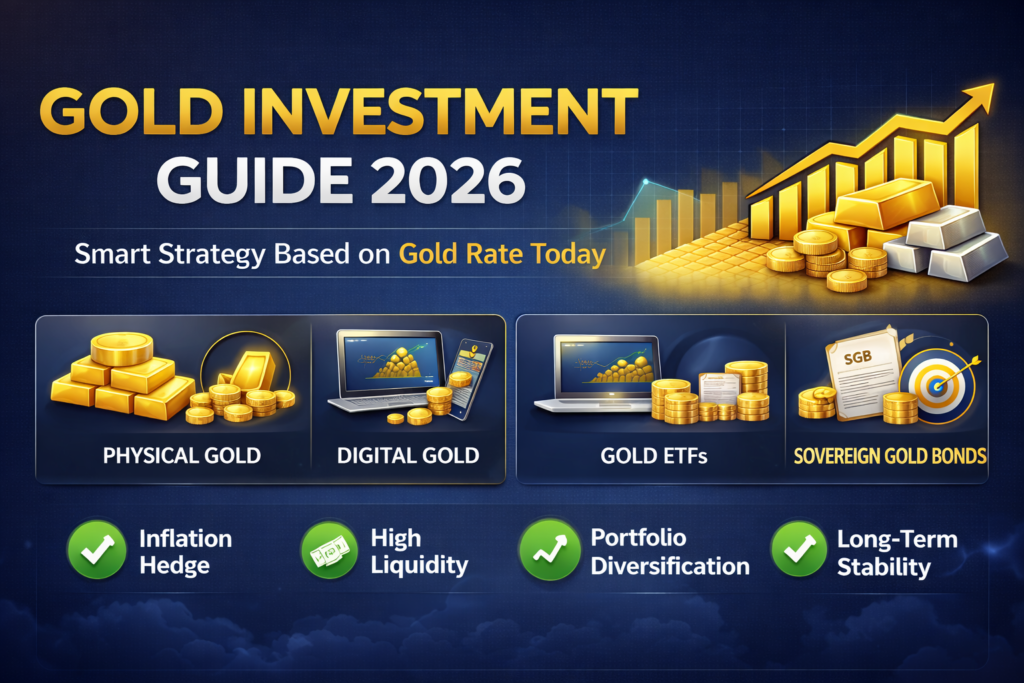
Different Ways to Invest in Gold
Modern investors have multiple options beyond traditional jewellery purchases.
1. Physical Gold
This includes:
- Gold coins
- Gold bars
- Jewellery
Before purchasing, check the prevailing gold rate today in India. Physical gold provides tangible ownership but includes storage risks and making charges.
2. Digital Gold
Digital gold allows investors to purchase gold online at the current gold price. It is stored securely in insured vaults. This option is convenient for small and regular investments.
3. Gold Exchange Traded Funds (ETFs)
Gold ETFs track gold prices and are traded on stock exchanges. They offer:
- Transparency
- High liquidity
- No storage risk
Investors who follow the gold rate today may prefer ETFs because prices closely reflect market movements.
4. Sovereign Gold Bonds (SGB)
SGBs are government-backed bonds linked to gold value. They provide:
- Fixed annual interest
- Price appreciation
- Tax benefits if held till maturity
For long-term investors, SGBs can be one of the most efficient gold investment options.
Benefits of Including Gold in Your Portfolio
Gold plays a stabilizing role in a diversified investment portfolio.
Main advantages include:
- Reduces overall portfolio risk
- Protects against inflation
- Provides liquidity during emergencies
- Performs well during stock market downturns
When equity markets fall sharply, gold prices often remain stable or increase.
Risks of Gold Investment
Although gold is considered safe, it is not risk-free.
Some risks include:
- Short-term price volatility
- No regular income (except SGB)
- Storage concerns for physical gold
- Making charges in jewellery
Investors should understand that while the gold rate in India may rise over time, prices can experience temporary corrections.
How Much Gold Should You Invest?
Financial experts typically recommend allocating 5% to 15% of your total investment portfolio to gold.
For example:
- Conservative investors: 10–15%
- Moderate investors: 5–10%
- Aggressive investors: 5%
Gold should support your investment strategy, not replace other asset classes.
Is It the Right Time to Invest Based on Gold Rate Today?
Many investors ask whether they should buy when prices are high or wait for corrections.
Instead of trying to perfectly time the market:
- Invest gradually
- Follow systematic investment
- Avoid emotional buying
- Diversify investments
Monitoring the gold rate today helps in understanding trends, but disciplined investing works better in the long term.
Gold Investment Strategy for 2026
In 2026, economic uncertainty, inflation concerns, and global market fluctuations continue to influence gold prices.
A smart strategy includes:
- Diversification across asset classes
- Balanced allocation
- Focus on purity
- Avoid heavy jewellery investment for wealth creation
- Consider SGB or ETFs for long-term holding
Investors who combine strategic planning with market awareness tend to achieve better financial stability.
Final Thoughts
This comprehensive gold investment guide shows that gold remains a powerful asset in 2026. While many people check the gold rate today or today gold price in India regularly, long-term financial planning matters more than daily fluctuations.
Gold should be part of a diversified portfolio, helping investors manage risk and preserve wealth during uncertain economic times.
With proper research, discipline, and allocation strategy, gold can strengthen your financial future.